London to Edinburgh
London to Edinburgh
East Coast Main Line
Routes on this map
London to Edinburgh on the East Coast Main Line is 632 km, and the fastest trains take 4 hours. LNER runs roughly every half hour, and the budget operator Lumo competes on the same tracks. The Flying Scotsman has left London at 10:00 on this route since 1862, and Mallard set the world speed record for steam here in 1938. It still stands.
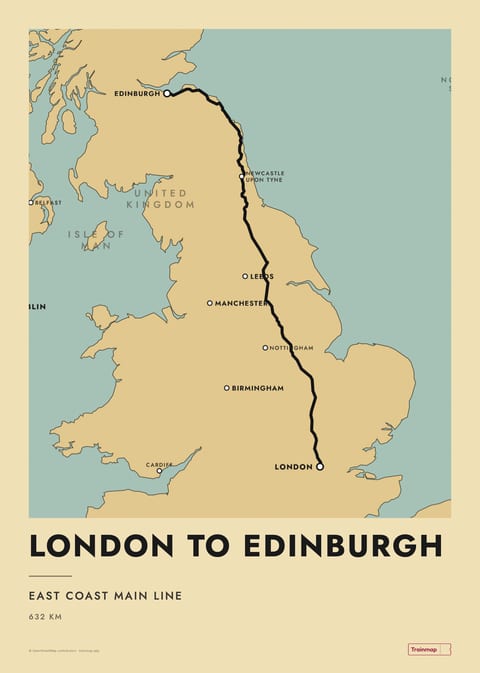
Route facts
| Duration | Fastest 4 h 00, typically ≈ 4 h 201 |
|---|---|
| Distance | 632 km (393 miles), King's Cross–Waverley2 |
| Operators | LNER (Azuma fleet, since 2018) and open-access Lumo3 |
| Reservations | Optional and free; Advance tickets come with a seat, flexible tickets are valid on any train1 |
| Fares (2026) | LNER Advance from £34.40; Lumo from ≈ £31.90; walk-up Anytime ≈ £205. Book at lner.co.uk / lumo.co.uk4 |
| Steam record | Mallard, 126 mph down Stoke Bank, 3 July 1938; still the world record for steam2 |
| Fastest ever run | 3 h 29 min, InterCity 225, 26 September 19912 |
Height along the route
Scenic highlights
- Durham. The approach over the viaduct looks across the city to the castle and the cathedral. Side to sit: right heading north (Seat 61).1
- Newcastle. The line crosses the River Tyne on the way into Newcastle, with the city's other bridges in view.1
- Northumberland coast. From Alnmouth northwards the line runs within sight of the sea, and Lindisfarne Castle shows on Holy Island. Side to sit: right heading north (Seat 61).1
- Royal Border Bridge. Robert Stephenson's viaduct of 1850 has 28 arches and stands 37 m above the Tweed at Berwick. Queen Victoria opened it, and it is Grade I listed.5
- Berwick to Dunbar. The line runs along the clifftops here, with the North Sea breaking on the rocks below. Side to sit: right northbound, left southbound (Seat 61).1
Stations on this route
- London Kings Cross
- Edinburgh Waverley
Three companies built the route in the 1840s, and the Flying Scotsman service has used it since 1862. On 1 May 1928 locomotive 4472 hauled it non-stop over the full 631 km for the first time (Flying Scotsman). Seat 61 puts the train's CO₂ emissions 84% below flying.
“The train is less hassle, cuts CO2 emissions by 84%, and is a genuine travel experience.”
Mark Smith, The Man in Seat 611
Related routes
Sources
Facts last checked 18 July 2026 · About Trainmap · All iconic routes
Map style
Everyday
Elevation
Classic
From space


Built by Arinbjörn, sometimes on a train · About
About & credits
Rail data: OpenStreetMap contributors (ODbL)
Stations: Trainline, Nominatim
Maps: OpenStreetMap contributors via Protomaps, self-hosted
Terrain: EU-DEM (Copernicus), USGS, NOAA et al.
Powered by MapLibre GL JS