Barcelona to Paris
Barcelona to Paris
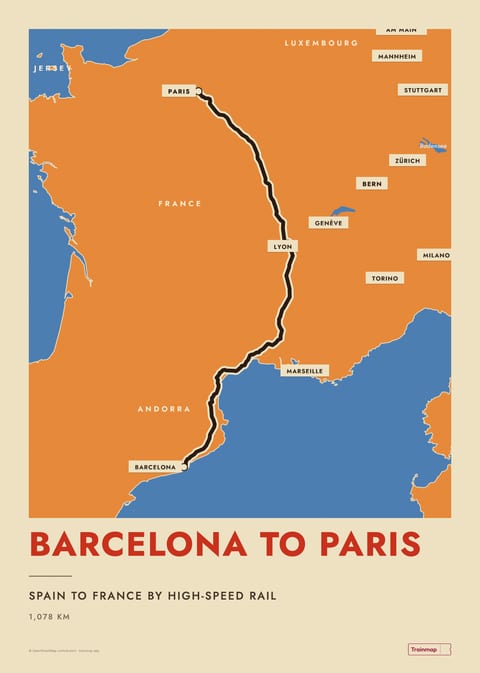
Spain to France by high-speed rail
Routes on this map
The TGV from Barcelona to Paris covers 1,073 km in about 6 h 40, at up to 320 km/h. SNCF runs it twice a day in each direction with double-deck TGV Duplex trains. At the Pyrenees it crosses the border through the 8.3 km Perthus Tunnel, the first rail link between Spain and the rest of Europe built without a change of gauge.
Route facts
| Duration | 6 h 39 – 6 h 50, two direct TGVs daily each way1 |
|---|---|
| Distance | 1,073 km at up to 320 km/h1 |
| Operator | SNCF TGV INOUI (sole operator since December 2022)2 |
| Border crossing | 8.3 km Perthus Tunnel under the Pyrenees3 |
| Reservations | All seats reserved, so every ticket includes one; passholders pay for a reservation1 |
| Fares (2026) | Advance from €39 (2nd) / €59 (1st); full-flex ≈ €259. Book up to 6 months ahead at sncf-connect.com1 |
| Direct since | 15 December 20133 |
Height along the route
Scenic highlights
- Rhône Valley. The TGV runs through the valley at about 300 km/h, past villages, churches and the odd château.1
- The étangs. Between Narbonne and Perpignan the line passes coastal lagoons with flamingos in the shallows, and the Mediterranean comes into view now and then.1
- Fort de Salses. The 15th-century Catalan fortress appears just before Perpignan. Side to sit: right travelling south (Seat 61).1
- Mt Canigou. The 2,784 m Pyrenean peak fills the view as the train leaves Perpignan for Spain. Side to sit: right southbound, left northbound (Seat 61).1
- Ride upstairs. On the double-deck Duplex, Seat 61 advises an upper-deck seat, which looks over the barriers beside the line.1
Stations on this route
- Barcelona Sants
- Paris Gare de Lyon
The cross-border high-speed line opened in stages, from Perpignan to Figueres in 2009 and through to Barcelona in January 2013. For almost ten years the joint venture "Renfe-SNCF in Cooperation" ran the route and carried more than 5.5 million passengers, until SNCF went alone in December 2022 (The New Barcelona Post). Seat 61 notes that flying between the two cities takes 4 to 5 hours in several separate stages, with roughly ten times the CO₂.
“Forget flying, chill out with a glass or two of red wine and enjoy the ride along the scenic Rhone Valley.”
Mark Smith, The Man in Seat 611
Related routes
Sources
Facts last checked 18 July 2026 · About Trainmap · All iconic routes
Map style
Everyday
Elevation
Classic
From space

Built by Arinbjörn, sometimes on a train · About
About & credits
Rail data: OpenStreetMap contributors (ODbL)
Stations: Trainline, Nominatim
Maps: OpenStreetMap contributors via Protomaps, self-hosted
Terrain: EU-DEM (Copernicus), USGS, NOAA et al.
Powered by MapLibre GL JS